Just days after a series of terrorist attacks in Paris, France left 129 people dead and over 350 others injured, Syrian refugees have once again become a topic for debate. It is believed that some of the terrorists gained access to Europe by using refugee status after a Syrian passport was found near the body of one of the suicide bombers from the attacks. However, Serbian police recently arrested a man carrying a Syrian passport with the exact same details as the documents found on the bomber in Paris and officials are almost certain now that both were forged in Turkey.

While the media both here and abroad have used this information to stoke the flames of Islamophobia, the president of the European Commission, Jean-Claude Juncker, has urged political leaders to continue to take in those fleeing from conflict. At the G20 summit in Turkey Juncker said, “Those who organized these attacks and those that perpetrated them are exactly those that the refugees are fleeing and not the opposite.”

According to CNN,
More than 250,000 people have died since the violence broke out in Syria in 2011, and at least 11 million people in the country of 22 million have fled their homes. Syrians are now the world’s largest refugee population, according to the United Nations.
President Barack Obama took to the podium at the same G20 summit to declare that the United States would stay committed to our plan of letting in 10,000 Syrian refugees despite governors from Alabama and Michigan announcing that they would reject refugees. Since his speech the list of states whose governors have stated that they would refuse to resettle Syrian refugees has grown to 27. There is no lawful means that grants state governors the authority to overrule the federal government on matters such as immigration policy. Nonetheless, governors from Alabama, Arizona, Arkansas, Florida, Georgia, Idaho, Illinois, Indiana, Iowa, Kansas, Louisiana, Maine, Massachusetts, Michigan, Mississippi, Nebraska, Nevada, New Hampshire, New Jersey, New Mexico, North Carolina, Ohio, Oklahoma, South Carolina, Tennessee, Texas, and Wisconsin have vowed not to cooperate with the federal government and to make it as difficult as possible for refugees to be relocated to their individual states.

Their main reasoning is that they believe refugees will pose a possible security threat. But this graphic might help dispute that claim:
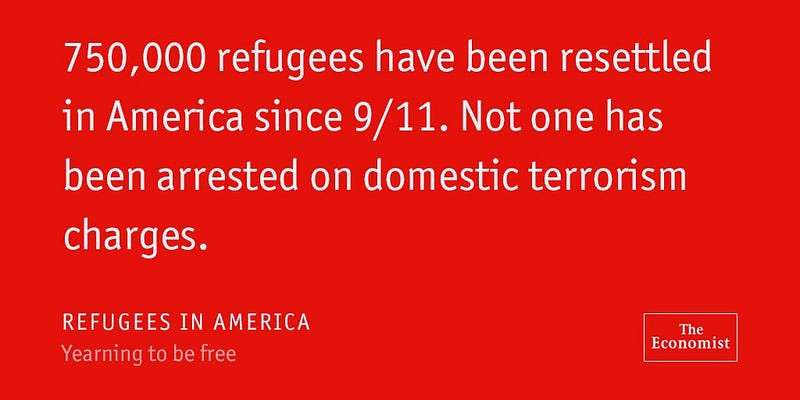


Given their views toward immigrants, particularly those of color, it probably doesn’t surprise anyone that 26 out of the 27 governors to make statements refusing refugees are Republican. And because this is America and some voters still want their leaders to have biblical values it should not come as a surprise that all 27 governors claim to be practicing Christians. I don’t have the authority to declare someone to be an authentic Christian or not. But, I do observe the actions of followers of Christ, especially in times of crisis because Scripture says, “By their fruit you will recognize them.”

Here is a quick reminder of what the Bible has to say about the treatment of refugees:
  • Leviticus 19:33–4: “When a stranger sojourns with you in your land, you shall not do him wrong. You shall treat the stranger who sojourns with you as the native among you, and you shall love him as yourself, for you were refugees in the land of Egypt: I am the Lord your God.
  • Exodus 22:21: “You shall not wrong a refugee or oppress him, for you were sojourners in the land of Egypt.”
  • Zechariah 7:9–10: “Thus says the Lord of hosts: render true judgments, show kindness and mercy to one another, do not oppress the widow, the fatherless, the refugee, or the poor, and let none of you devise evil against another in your heart.”
  • Malachi 3:5: “I will be a swift witness against…those who oppress the hired worker in his wages, the widow and the fatherless, against those who thrust aside the refugee, and do not fear me, says the Lord of hosts.”
  • Isaiah 3:4: “Give counsel; grant justice; make your shade like night at the height of noon; shelter the outcasts…”
  • Deuteronomy 27:19: “Cursed be anyone who deprives refugees of justice.”
  • Ephesians 2:9: “So then you are no longer strangers and aliens, but you are fellow citizens with the saints and members of the household of God.”
  • Jeremiah 22:3: “Thus says the Lord: Do justice and righteousness, and deliver from the hand of the oppressor him who has been robbed. And do no wrong or violence to the resident alien, the fatherless, and the widow, nor shed innocent blood in this place.”
  • Hebrews 13:2: “Do not neglect to show hospitality to strangers, for thereby some have entertained angels unawares.”
  • Matthew 25:35: “For I was hungry and you gave me something to eat, I was thirsty and you gave me something to drink, I was a stranger and you invited me in.”
As the season of advent quickly approaches I am reminded of the birth narrative of Jesus and how Mary and Joseph became refugees as they fled from the murderous King Herod. One would think this obvious parallel between the life of Jesus and the lives of refugees all over the globe escaping war, oppression, and inhumane treatment would be enough for all of our political leaders to show compassion, instead they prove to be heartless and callous. Imagine if the so-called biblical values of these political leaders extended beyond policing both how women treat their bodies and who people choose to marry. Christians should push those leaders that claim to share the same faith as them to act according to Scripture and to not allow their states to become safe havens for racism, Islamophobia and xenophobia.
I recently picked up a fascinating book called Octavia's Brood co-edited by Walidah Imarisha and adrienne maree brown. In a discussion about the book Walidah Imarisha said, "All organizing is science fiction. What does a world without poverty look like? What does a world without prison look like? What does a world with everyone having enough food and clothing look like? We don't know. It's science fiction, and it is as foreign to us as the Klingon home world."
I had never heard of organizing being discussed in such a way and it led me to reflect on the importance of envisioning and dreaming of the society for which we fight to create. I also found myself reflecting on this statement in a different light. All organizing is also theological and spiritual. A simple explanation of this is that organizing/activism is faith in action. As Christians, justice is at the heart of our discipleship. We are called to fight for and with the marginalized and the oppressed so that every person's humanity is recognized to the fullest extent and equity becomes a reality. But when we work vigorously toward this goal we are doing more than just being faithful and obedient to our call, we are attempting to embody and bring into fruition the summation of the Christian message: a 'New Creation.'

Read the entire article HERE.
"Tell them about your dream, Martin."


These words spoken to Martin Luther King Jr. 52 years ago on August 28, 1963 by Mahalia Jackson inspired perhaps the most well-known prophetic use of spiritual imagination in modern history. King's "I Have A Dream" speech was filled with hope and radical imagery. King envisioned a nation where injustice and oppression were no longer prevalent -- a nation so transformed by hope and love that freedom and justice rang "from every state and every city." This kind of dream, conceived with a keen spiritual imagination, is integral to the foundation of any liberating work. As the great spiritual writer C.S. Lewis argued, "reason is the natural organ of truth; but imagination is the organ of meaning. Imagination, producing new metaphors or revivifying old, is not the cause of truth, but its condition." In other words, we do not really grasp the meaning of any concept until we have a clear image that we can connect with it. We cannot create a better world if we do not first envision a better world. We cannot liberate ourselves if we do not imagine what liberation looks like. We cannot fight for justice if we are stuck with only images of injustice. As we continue the struggle for the liberation of all oppressed people we must let our imaginations run wild. We must dream.

Dreaming in both the literal and figurative sense is essential to creating a better world. Jan Born, a neuroscientist at the University of Lübeck, argues that, "deep sleep and dreaming 'set the stage for the emergence of insight' by allowing us to mentally represent old ideas in new ways." This is essentially what Dr. King did when he detailed what it would look like if America lived out the true meaning of its creed: "We hold these truths to be self-evident, that all men are created equal."

According to Sara Mednick, a neuroscientist at the University of California, San Diego, REM sleep is an essential component of creativity. "REM 'primes associative networks' allowing us to integrate new information into our problem-solving approach." Systemic evil is constantly evolving and may manifest itself differently over time. That is why we must remain creative and use our imagination to develop the most efficient ways to push back against systems of oppression. Methods that worked for past generations might not necessarily be effective in our generation's current struggle for freedom and equality.

While there are several psychological reasons why dreaming is important, there are also physiological reasons. According to Dr. J. Allan Hobson, the major function of the rapid eye movement (REM) sleep associated with dreams is physiological and during this time the "brain is activated and 'warming its circuits' and is anticipating the sights, sounds and emotions of the waking state." When we envision a better future we engage in the exercise of creating hope. We prepare our mind, body, and soul for the work that must be done to ensure the future we imagine comes to fruition.

In the Bible, dreams and visions were often used by God to communicate with people and to reveal God's plan. God utilized this method to create a bridge between the realm of the divine and the realm of flesh. Ultimately, though, Jesus stands in this gap as God made flesh. The goal of faith based activism is to create a better world. And if it is truly Kingdom building work then the life and ministry of Jesus stand as the perfect vision of the principles on which this new world is to be built -- principles such as love, compassion, sacrifice, humility, faithfulness, and justice. We have never tangibly seen this new world in its entirety. Therefore, it is necessary that we cultivate a spiritual imagination similar to Dr. King's. One that allows us to dream of infinite possibilities. Each time we use our spiritual imagination to dream of a better world we break down barriers that exist between the worldly and other-worldly. Dreams give us the ability to access this distant realm or alternate reality, a reality occupied only by God. We are able to transcend the hopelessness and despair that some of us might experience through the conditions created by our present world.

Lack of vision and underutilizing the discipline of cultivating a spiritual imagination is a cause for concern. In biblical times this was often a sign of disobedience. In today's society the absence of an active spiritual imagination can be demoralizing and paralyzing. Dreams are the first step in creating space for mobility. They give us hope and set our path. Without them we run the risk of mistaking realism for our reality.

For those of us involved in the Black Lives Matter movement it is vital that we carry on the tradition of dreaming. Our ancestors dreamed of the impossible and then worked tirelessly to make it possible. The world that is meant for us has still not yet come, but a part of it exists in us as hope and that hope drives us to fight for it. We must stay faithful prisoners of hope to break the chains of systemic evil. What is your dream for tomorrow? What does freedom look like to you?
One of the most frustrating aspects of social justice work is waiting for your hard work and dedication to finally pay off. Why must we wait so long to see change actually happen? It is not uncommon for a person to work their entire life toward affecting change and never get the result they desire. Following in the footsteps of our ancestors and the prophets of the Bible, when our patience is tested we begin to petition God and solicit God's presence and activity in our society. Where are you God? How long will you allow the unrighteous to reign supreme and for injustice to pervade our world? This becomes one of the biggest tests of faith. Do we truly believe God will be faithful to the promise to bring about justice? If so, when we become involved in a social movement of protest where the central methodology is nonviolent resistance, are we essentially agreeing with the sentiment that we must wait on the Lord?


Read the entire article HERE.

"I have never felt closer to a higher power than since the protests began." - Deray McKesson

There is a lot of truth in this statement. I feel this way, in part, because I am living out God's calling on my life. As a Christian I have always felt the call to use my faith to become an agent of change and to be a part of a community that is seeking to transform society. In various ways I have worked toward accomplishing that throughout my life. But never before has my work felt so validated. And never before have I felt like the presence of God and the activity of God was so abundantly clear.

I spend a lot of time reflecting on the past seven months. My life has completely changed since August 9th, the day Michael Brown was murdered by police officer Darren Wilson. Despite this tragedy and the hardship that has followed there have been many good things that have come as a result of our fight for justice. I think about the community that has been built. I think about the friendships that have been formed. I think about the art and music that have been created. I think about the theology that has been constructed. In all of this I see the face of God. In my attempt to follow the advice given by the psalmist to "Look to the Lord and his strength; seek his face always," I have found confirmation that God is truly on the side of the oppressed, marginalized, and downtrodden. It might not seem this way because we have a long battle to fight and the odds are constantly stacking up against us, but it was at that exact point in the life of Jesus, when the world had thrown all that it could throw at him, that the ultimate power and will of God was revealed.

The work that is being done through the Black Lives Matter movement is righteous. It is a faithful witness to the radical ministry of Jesus Christ and evidence of obedience to the mandate to love. Although this movement began as a result of the growing intolerance to the unjust and brutal treatment of Black people by those sworn to protect and serve us, it is deeply rooted in love. It is not anger, fear, or frustration that motivates most of us, but it is hope and love. Had the foundation of this movement been anything other than love we would be at a totally different place right now. Throughout history there has only been one type of response to the kind of injustices the Black community faces today in America and that is one of violent resistance. But for the betterment of society we have chosen a different path, for as Martin Luther King Jr. once said, "Darkness cannot drive out darkness; only light can do that. Hate cannot drive out hate; only love can do that." A special kind of love has to be cultivated and diffused to both overcome evil and sustain a people whose humanity has been violated for centuries and whose dignity is threatened on a daily basis.

This special kind of love exists in the midst of Blackness as Black love; a love that emanates from God and is a central place to where we find the perfect image of God. Black love is powerful because it functions as a strong bond formed between brothers and sisters caught up in the same struggle; it is expressed romantically unrestricted by sexual and gender norms; and it overflows as redemptive goodwill seeking to preserve and create community. Every expression of love is triadic therefore every expression of love points to the triune God.

When the great theologian and early Church Father Augustine wrote about the Trinity he reasoned that we could not catch intellectual sight of the Trinity directly, but because we are made in the image of God we should expect to see something that reflects the Trinity in us. In his work, De Trinitate (On the Trinity), Augustine details several psychological analogies of the Trinity, one of which is the mind, self-knowledge, and self-love. Based on 1 John 4:8,  he links the triads found in loving something (the act of one who is loving something, the love itself, and the object that is loved) and in the process of contemplation (the mind that desires to know something, the activity of knowing, and the object that is known) to God's own movement found in the Trinity.

You cannot love that which you do not know therefore self-love implies self-knowledge. As Augustine writes, "The mind is not able to love itself unless it also knows itself." In a similar manner Black love is imperfect without knowledge of Blackness. Black awareness is a co-product of the love of Blackness. In other words, Black love implies Black awareness. Thus, producing a trinity of Blackness, Black awareness, and Black love. This trinity is a reminder of God's proximity to the disinherited people of this world.

Blackness exposes many evils that exist in society, some of which become internalized. When we push back against these evils through love we align ourselves with the will of God and become in tune with the vision that God has for this world. As we move forward in the fight for justice and continue to discuss and improve our understanding of Blackness and all that it encompasses we will undoubtedly continue to see reflections of God.
Next PostNewer Posts Previous PostOlder Posts Home