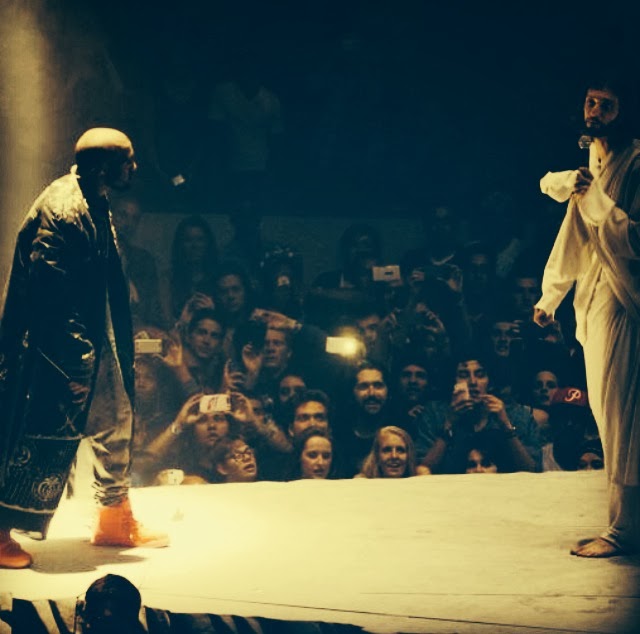
On the opening night of the Yeezus Tour, multi-platinum, Grammy award-winning rapper Kanye West brought out an actor to portray Jesus during his concert in Seattle. Most of the time when I see "White Jesus" depicted, I don't get offended because I don't find it to be historically accurate. But between this and the title and theme of Kanye's last album, Yeezus, I was initially fed up. His antics were disrespectful, offensive, and just plain unnecessary.

Before I began to write this post I searched for concert footage of the event, but I stumbled upon an interview Kanye had with Wild 94, a hit music station in San Francisco. During the interview, which was done a few days after his Seattle performance, he was given the opportunity to explain his motives behind bringing out Jesus.

"We do plays all the time. People play Jesus,” West said. “You know what’s awesome about Christianity is we’re allowed to portray God. It’s a painting, it’s a sculpture, it’s a moving opera, it’s a play, it’s a message. God knows where my heart is at.”

Then came the comment that changed the entire direction of this post:

“One of the things that I really wanted to get across is that you can have a relationship with Jesus. That you can talk to Jesus. This is the way I express it.”


After hearing this I was forced to take a step back and reflect on the type of relationship many rappers have with Jesus. Rap music, similar to the blues, arose from the plight of the black community. We can still hear the agony, frustration, and struggle from artists who give us a glimpse into the world in which they grew up and the one in which they currently live. It is out of that anguish that many of these artists connect with the gospel.

Some of the work of artists such as Tupac Shakur, Nas, DMX, Common, Jay Z, J. Cole, Kendrick Lamar, Joe Budden, The Clipse, Lupe Fiasco, and Kanye West can be profoundly theological. The church has been too quick to dismiss the theological implications found in the music of these artists because of the coarseness and vulgarity of the music, the contradictions that are often found in the lifestyles of these rappers, and a general lack of understanding of rap culture.

However, the faith of such artists and individuals who grew up and live in similar inner-city environments and deal with the same kind of temptations and demons (i.e., drugs, sex, and violence) is very authentic. That type of faith cannot be comprehended by middle-class or upper-middle-class Christians because the type of saving that needs to take place is not one exclusively spiritual. In fact, it cannot even be comprehended by most Christians because it is not draped in false piety.

The type of faith exhibited by these individuals is very rugged and, according to Dr. Daniel White Hodge, their theology engages, "the profane, the secular, and the sacred—an area frightening to those still etched and stooped in the hallways of simplistic and 'milk' theological paradigms."

"This type of theology," Hodge writes, "creates space outside the traditional corridors of God searching; it opens up the door for those who do not 'fit' an approved or established approach to being a spiritual person; it is the way for the n----, the thug, and the ‘hood rat to find God in a space God can meet them in."

You do not have to be holy to come to God.

That very space, outside of the norm, is a place that the church has denied recognition out of an attempt to monopolize the rules of spirituality. What we have done in the church is both erroneous and fallacious considering that biblically it is that space where we find Jesus dwelling. Matthew 28:16-20, otherwise known as the Great Commission, does not tell us to condemn, shun, or judge from afar and wait for those who have failed to abide by our precepts to come to us in shame. Jesus commands us to go. Therefore, it should be the obligation of the church to meet such individuals exactly where they are.

I consider some of the theology I have heard in rap music to be quite prophetic. Although, I will admit that not all of it is solid or strong and can lead to unsound doctrine. But instead of labeling them unChristian or belittling their faith, we should help nurture and mature it.

Many of these rappers are searching for guidance, moral vision, and ethical direction as explained by Michael Eric Dyson, professor of sociology at Georgetown University. If we take their theological offerings serious it will prove to be a valuable insight on how to affect change in an urban setting where most individuals would identify with hip-hop culture.

I’m still unsure of how I feel about Mr. West’s onstage conversation with Christ. After hearing him give the meaning of the portrayal and the intent behind it, I don’t find it nearly as offensive and disrespectful as I initially did. It may have been over the top, but what better place to bring out Jesus than at a rap concert?
Life is hard. No matter who you are at some point in time you have felt this overwhelming feeling. For many of us it centers on money or family or life decisions or all of those and more. Interestingly enough no one seems to be able to escape this feeling. Not even the rich and famous are immune; in fact in some ways maybe it takes an even greater toll on them. How often do we see troubled celebrities, people that we just wish we had half of what they have or could be half as famous as they are? How often are we baffled when we hear that our favorite celebrity, that we love and envy, has been admitted to rehab or even worse committed suicide? Life undoubtedly has its challenges and they always seem to hit at just the worse time and in the worse way possible.

The interesting thing is everyone’s life hardships are different and it’s not really fair to condemn anyone for not having challenges that are as bad as others. This thing called life comes in many shapes and sizes. A person who can’t afford to pay their car note this month because they lost their job and now may lose their transportation to a new job has the right to worry just as much as a mom who has 4 children in a small village in some third world country and can’t provide them with the food or shelter they need. 
Now of course, we can all agree that some hardships are definitely worse than others in the grand scheme of things. At the end of the day the person who can’t pay his car note probably still has food to eat and a roof over his head for a little while and has a decent chance of finding another job that will restore his way of life or maybe family that is in a decent enough situation to help. Whereas, the mother who can’t supply for her children is probably surrounded by poverty with no real or imaginable way out. 

All this helps me put things into perspective as it relates to my life and the hardships I come across. Many people wonder why I am always so upbeat, happy, or nonchalant and it’s because I live by the saying, "It could always be worse". I didn't make it up and I'm sure you have heard it before but  I do a pretty good job of putting it to use. In fact the bible speaks to this in Matthew 6:27-29 NLT, "Can all your worries add a single moment to your life? And why worry about your clothing? Look at the lilies of the field and how they grow. They don't work or make their clothing, yet Solomon in all his glory was not dressed as beautifully as they are." The thing is, this saying only works for me because of my strong faith in Jesus Christ and the lord above. 

I realize how truly blessed I am everyday compared to others in this world. I didn’t do anything extra to deserve not to be born in a third world country or to have two loving parents. I don't deserve 99% of the good fortune I have any more than the next person, but God blessed me with it. So how dare I take it for granted or fail to put things into perspective when things get rough. My other saying is, "My worst day is 10 times better than some people’s best day." How can I possibly let a rough day get me down when I say that out loud??? The bible speaks to this in Philippians 4:11-12 ESV, "Not that I am speaking of being in need, for I have learned in whatever situation I am to be content. I know how to be brought low, and I know how to abound. In any and every circumstance, I have learned the secret of facing plenty and hunger, abundance and need." 

Staying positive and hopeful because you know you dwell in God’s grace is an amazing feeling and I believe it perpetuates. Worrying and being negative only takes a greater toll on the human body. Proverbs 17:22 ESV states, "A joyful heart is good medicine, but a crushed spirit dries up the bones." My dad instilled in me the value of not wasting time worrying about things because God has blessed me with the talent and strength to do anything and overcome anything. I leave you with this, when times get hard believe harder, stay positive, and move forward with God. 
Romans 15:13 ESV, "May the God of hope fill you with all joy and peace in believing, so that by the power of the Holy Spirit you may abound in hope."


1.  WATCH: God's Justice Never Shuts Down — Jim Wallis on #FaithfulFilibuster
Jim Wallis talks about the #FaithfulFilibuster outside the Capitol Building and offers a reading of his conversion text, Matthew 25...watch here
2.  Where There Is No Guidance
Proverbs 11:14 speaks volumes in the context of the black community. It is no secret that African American communities tend to be plagued with poor school systems, poor medical access, high incarceration rates, broken families, and of course (in light of the recent Trayvon Martin incident), violence and profiling. With all of these factors and stressors in life, it is of little wonder that many Blacks appear to be self-destructing...continue reading
3.  Faithful Filibuster: Christian leaders read Scripture, exhort Congress to care
Under a cloudy and drizzly sky, across the street from the U.S. Capitol, David Beckmann read passages from the prophet Isaiah. “Comfort, comfort my people, says your God,” read Beckmann,  president of Bread for the World and one of several Protestant and Catholic leaders who gathered Wednesday (Oct. 9) to launch...continue reading
4.  Can Online Communion Be a Substitute for the Real Thing?
As online worship becomes more common in some churches, leaders within the United Methodist Church are debating whether the denomination should condone online Communion. About 30 denominational leaders met last week after Central United Methodist Church in Concord, N.C., announced plans to launch an online campus that potentially would offer online Communion...continue reading
5.  When Love Walks Away
For some reason, there is this piece of relationship advice that says “if you love something, let it go.” Quite honestly, I’ve found this to be remarkably poor advice. A relationship, after all, is a commitment. It means that when challenge arises (and it will), both parties are committed to working through it. The idea of simply walking away only enters the picture when all other avenues have been explored and the only healthy option for both people is to go their own separate ways...continue reading

At the end of the summer many of us watched the verdict in the Zimmerman case with great concern, even worry. We sat with knotted stomachs, aching hearts, and frazzled nerves waiting for a just verdict but anticipating one that would once again bring us to a very unsettling place around the issues of race and violence in America. We’ve been here too many times before – stuck in a vortex of sorts, where we struggle mightily for a moral anchor for our feelings, our fears, and our outrage but knowing all the while that as a society we lack the moral courage to confront ourselves and our history.

As a Black clergy person, who is working with PICO National Network’s Lifelines To Healing Campaign, I was praying for a verdict that would demonstrate that the American justice system possessed both the capacity and the intent to value Black life. Waiting for that same system to demonstrate to the American people that the laws and policies that preserve the fruits of democracy for the privileged are also extended to those who live at the margins. Simply put, I and many of my clergy colleagues, and so many other Americans, were waiting for a sign that the instruments of justice and governance would bend to include us.

We waited for the Supreme Court to render its verdict re-validating the Voting Rights Act. Sadly, in my estimation, we waited in vain. We waited for the verdict from the Supreme Court that we hoped would lend new support for affirmative action strategies as remedy for long-standing racial inequities in higher education and employment. Again, we waited in vain. As we mourned the senseless loss of life in Newtown earlier in the year and the veritable orgy of violence and death ongoing in Chicago, we patiently waited for the administration and Congress to act on sensible gun legislation. Our waiting again, produced no fruitful policy change, no legal respite, no moral response.

And we waited for a Florida jury to pass judgment on a case that brings into question many of our deepest racial fears and animosities. Waiting this time, for an all-white Southern jury to render a verdict that would bring justice to a case, that had at its heart the senseless loss of a precious child, seemed like the most perverse kind of waiting. We’re waiting for the time when true racial justice will be realized, and knowing in our hearts all along that that time has not yet arrived because we haven’t the moral courage or clarity to work to make it so.

Fifty years ago, at the height of the civil rights movement, Dr. Martin Luther King, Jr. pricked the nation’s moral conscience in a letter that he penned from a dank jail cell in Birmingham, Alabama. He declared with great moral exasperation that the time for waiting for justice had come and gone.  At the top of his prophetic voice he proclaimed, “For years now I have heard the word "wait!" It rings in the ear of every Negro with piercing familiarity. This "Wait" has almost always meant "Never." We must come to see…that "justice too long delayed is justice denied."

His words still ring true today; we cannot continue to wait for justice. We shouldn’t expect that the wheels of the American system will turn in our direction without applying the grease of moral outrage and organized action. We should not expect that which we are not willing to labor for, even suffer for.

Dr. King goes on in his letter to indict our tendency to wait on justice as a “tragic misconception of time.” He asserts that in all of our waiting we conspire with those of “ill will” to delay, defer and deny. We misuse time to allow us distance from the moral imperative of “now action” and we allow time to seduce us into complacency - and ultimately complicity.

Time is on the side of those with moral courage. Time is on the side of those who would work to make commonsense gun laws the law of the land. Time is on the side of those who would fight for voting rights for every American, including those returning from incarceration. Time is on the side of those who would advance laws ensuring everyone a fair chance at opportunity. Time is on the side of those who value the lives of young Black men.

We must pull ourselves out of this moral vortex. We must carry our voices into the public square and have our say on issues that define our democracy and determine our freedoms. We must organize our communities to develop collective power. And we must use that power to press for real justice - now is the time to challenge ourselves to use time in the service of justice.

- Rev. Alvin Herring is the Director of Training and Development for The PICO National Network

The Lifelines to Healing Campaign is a national movement of the PICO network of faith-based organizations and congregations committed to addressing the causes of pervasive violence and crime in our communities. We believe that the criminalization and mass incarceration of people of color, coupled with the lack of meaningful and quality opportunities, have contributed to a state of crisis in our country. Lifelines to Healing is committed to advocating for policies and resources that contribute to the healing of our communities.


1. Dispensationalists Are Wrong – Things Aren’t Getting Worse [Questions That Haunt]
Dispensationalism is a recent and minority opinion. Invented in the 19th century, it is premised on a particularly literalistic reading of particular Bible passages in Revelation, Daniel, and certain sayings of Jesus. In order to be a Dispensationalist, for example, one must completely ignore the realities surrounding the apocalyptic genre of literature in the Ancient Near East — realities that make sense of the “revelations” in Daniel, Revelation, and even in Jesus’ more apocalyptic sayings...continue reading
2. Can A Community Of Faith Decrease Recidivism?
Does anyone love me? Is there a point to all this? We all tend to ask ourselves these questions time and time again. For a person coming out of jail, these questions seem to have even more weight. Does anyone love me after what I've done? Where is my life going after being behind bars...continue reading
3. 3 Reasons You Should Reject the Prosperity Gospel
Many preachers of Los Angeles, New York, and every city in between are proclaiming what has come to be known as “the prosperity gospel.” The prosperity gospel is a label used to describe the popular teaching that Christians are promised prosperity in their finances, health, and life pursuits as God’s response to their faith in him and his promises...continue reading
4. I’m a Christian and I Swear…Occasionally.
I swear now. I haven’t always swore. I started swearing more -in jest- when I started Seminary and met a more liberal Christian than I’d been used to. But it’s been the past two years that kicked it up a notch. It wasn’t a big deal until I started being more free with my choice words online. Today, I’m linking up with Bethany Suckrow’s Explicit Realities, Explicit Language post about how she was confronted on behalf of my language...continue reading
5. Replacing Faith with Curiosity
Every day, my previously stable faith is replaced with a little more hungry curiosity. I consider this progress. Have posted this brief statement on my Facebook and twitter accounts yesterday and promptly received quite a bit of interest in return. Not surprising, really, that my typical readership would resonate with such a claim, but I also found some surprising affirmations from those I would not have expected to appreciate my sentiments...continue reading

Next PostNewer Posts Previous PostOlder Posts Home