Recently, my friend Gerry Cooper (@cooplemoderne) released a wonderful montage (which can be viewed at the end of this post) exploring the different ways in which we experience and define love. I was fortunate enough to be featured in this short documentary. After viewing it and being reminded of my response to the question, "What is love?" I thought it would be fitting to again examine the concept of love. Although we are in the season of romantic love, it is best to talk about all the ways in which we experience love and diffuse love. There is never a bad time to discuss love, but now more than ever is the right time. We are in the midst of a social movement unlike anything this nation has seen in decades. And we are also at the beginning of the Lenten season, a sacred season where we strive to reorient our lives to God, the source of love.
 
Love, much like God, is too big of a concept to try to define. There are neither enough words nor the right words to begin to form a proper definition. Love is something that we experience, feel or sense and because the ultimate source of love is the triune God we experience love in a triadic nature. In the Bible there are three Greek words used to describe love:
 
1) eros- erotic/romantic love
2) philia- affectionate regard, friendship
3) agape- unconditional love
 
According to Dr. Cornel West, "Justice is what love looks like in public." While we are working to reimagine justice so that it extends to all people and not just those of the dominant culture, we are also working to reimagine love. In many ways we already have. When it comes to eros love, we have found that it does not fit neatly into our concepts of gender or sexuality. We desire who we desire. The romantic relationships and unions formed in the midst of this current movement are both revolutionary and necessary. It is transforming to recognize the beauty in another person and to have the beauty inside of you recognized. Truth is found in these relationships and they go on to form the foundation of the most important social unity of society; family.
 
We have also begun to reimagine philia love. This has mostly been done by the friendships that have been created in the struggle. Not only has the movement inspired the rebuilding of a community continuously devastated by seemingly endless cycles of injustice and oppression, but it has also inspired the reformation of community to be inclusive of those historically pushed to the fringes of society and to be connected to other oppressed groups around the globe. These companionships bridge the gaps in broken community and are a threat to an empire that thrives on divisiveness.
 
Agape love is the most important idea of love because it is selfless and altruistic. It is the love that flows from the character of God and the thrusting force that placed us in the streets to fearlessly confront the corrupt and unjust systems that oversee and carryout the destruction of Black life. Agape love is love in action. In America, this kind of love was arguably best imagined publicly by Dr. Martin Luther King Jr. who used it as the basis for nonviolent resistance. However, love is often misinterpreted and many continue to think of agape love as being weak and passive because of its willingness to forgive.
 
It is true that loving and forgiving your oppressor closely resembles an abusive relationship rather than resembling a person seeking liberation. But because agape love extends from God it needs no reimagining, it only needs to be imagined fully or perhaps reexamined thoroughly. Dr. King began this process shortly before his assassination. In his annual report delivered at the 11th Convention of the Southern Christian Leadership Conference in 1967 King said,
 
"...Power properly understood is nothing but the ability to achieve purpose. It is the strength required to bring about social, political, and economic change.

... Now a lot of us are preachers, and all of us have our moral convictions and concerns, and so often we have problems with power. But there is nothing wrong with power if power is used correctly.

You see, what happened is that some of our philosophers got off base. And one of the great problems of history is that the concepts of love and power have usually been contrasted as opposites, polar opposites, so that love is identified with a resignation of power, and power with a denial of love. It was this misinterpretation that caused the philosopher Nietzsche, who was a philosopher of the will to power, to reject the Christian concept of love. It was this same misinterpretation which induced Christian theologians to reject Nietzsche's philosophy of the will to power in the name of the Christian idea of love.

Now, we got to get this thing right. What is needed is a realization that power without love is reckless and abusive, and that love without power is sentimental and anemic. Power at its best is love implementing the demands of justice, and justice at its best is love correcting everything that stands against love. And this is what we must see as we move on."
Love is a powerful force. It may not be the only way to break the chains of oppression, but it is the only way to ensure those chains don't wind up shackled on any other group of people. It is up to us to continue the process of understanding agape love in totality and to use that knowledge to radically love and to dramatically transform the world we live in.

________________________________________________________________

❤️ (Untitled, Pt. II), A Montage By Gerry Cooper

Circa S/S 2015

Featuring a host peers, "❤️ (Untitled, Pt. II)" is part montage, part documentary, part case study exploring the one thing all people have dealt with in some shape, form, or fashion: LOVE. Though a cliche subject, the mission was to get a deeper understanding of what people define as love, what it feels like, and if they even feel it exists. Truly a collaborative effort, ❤️ is narrated with original poetry by writer/artist Joy Priest and has video submissions + interviews from over 15 people. 90's style VHS footage, clips from some of your favorite shows/movies, plus a blissful soundtrack help bring this project to life.

Directed, Produced, & Edited by Gerry Cooper
Narration & Original Poetry by Joy Priest
❤️ title created by Big Chetti

Featuring: Joe Piper, Susan Phillips, Marcos G. Morales, Rebeca Maldonado, Alexis Savage, Domdi, Ryan Herring, Imani Williams, Vern Tolbert, Alexis Holland, Taylor Cochran, Bonez, James Lindsey, Trap Adams, Amani Miles, Infitain, and Malachi Shockley.

Twitter: @CoopLeModerne, @dalai_mama_, @bigchetti
Instagram: @CoopLeModerne, @dalai_mama, @big_chetti


Just days after a series of terrorist attacks in Paris, France left 129 people dead and over 350 others injured, Syrian refugees have once again become a topic for debate. It is believed that some of the terrorists gained access to Europe by using refugee status after a Syrian passport was found near the body of one of the suicide bombers from the attacks. However, Serbian police recently arrested a man carrying a Syrian passport with the exact same details as the documents found on the bomber in Paris and officials are almost certain now that both were forged in Turkey.

While the media both here and abroad have used this information to stoke the flames of Islamophobia, the president of the European Commission, Jean-Claude Juncker, has urged political leaders to continue to take in those fleeing from conflict. At the G20 summit in Turkey Juncker said, “Those who organized these attacks and those that perpetrated them are exactly those that the refugees are fleeing and not the opposite.”

According to CNN,
More than 250,000 people have died since the violence broke out in Syria in 2011, and at least 11 million people in the country of 22 million have fled their homes. Syrians are now the world’s largest refugee population, according to the United Nations.
President Barack Obama took to the podium at the same G20 summit to declare that the United States would stay committed to our plan of letting in 10,000 Syrian refugees despite governors from Alabama and Michigan announcing that they would reject refugees. Since his speech the list of states whose governors have stated that they would refuse to resettle Syrian refugees has grown to 27. There is no lawful means that grants state governors the authority to overrule the federal government on matters such as immigration policy. Nonetheless, governors from Alabama, Arizona, Arkansas, Florida, Georgia, Idaho, Illinois, Indiana, Iowa, Kansas, Louisiana, Maine, Massachusetts, Michigan, Mississippi, Nebraska, Nevada, New Hampshire, New Jersey, New Mexico, North Carolina, Ohio, Oklahoma, South Carolina, Tennessee, Texas, and Wisconsin have vowed not to cooperate with the federal government and to make it as difficult as possible for refugees to be relocated to their individual states.

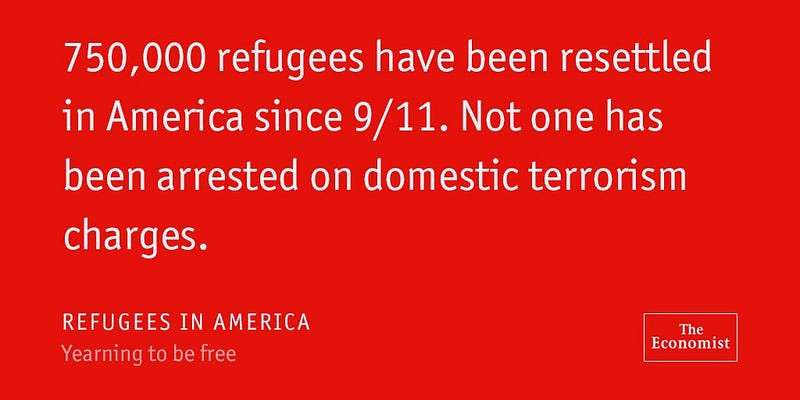
Their main reasoning is that they believe refugees will pose a possible security threat. But this graphic might help dispute that claim:


Given their views toward immigrants, particularly those of color, it probably doesn’t surprise anyone that 26 out of the 27 governors to make statements refusing refugees are Republican. And because this is America and some voters still want their leaders to have biblical values it should not come as a surprise that all 27 governors claim to be practicing Christians. I don’t have the authority to declare someone to be an authentic Christian or not. But, I do observe the actions of followers of Christ, especially in times of crisis because Scripture says, “By their fruit you will recognize them.”

Here is a quick reminder of what the Bible has to say about the treatment of refugees:
  • Leviticus 19:33–4: “When a stranger sojourns with you in your land, you shall not do him wrong. You shall treat the stranger who sojourns with you as the native among you, and you shall love him as yourself, for you were refugees in the land of Egypt: I am the Lord your God.
  • Exodus 22:21: “You shall not wrong a refugee or oppress him, for you were sojourners in the land of Egypt.”
  • Zechariah 7:9–10: “Thus says the Lord of hosts: render true judgments, show kindness and mercy to one another, do not oppress the widow, the fatherless, the refugee, or the poor, and let none of you devise evil against another in your heart.”
  • Malachi 3:5: “I will be a swift witness against…those who oppress the hired worker in his wages, the widow and the fatherless, against those who thrust aside the refugee, and do not fear me, says the Lord of hosts.”
  • Isaiah 3:4: “Give counsel; grant justice; make your shade like night at the height of noon; shelter the outcasts…”
  • Deuteronomy 27:19: “Cursed be anyone who deprives refugees of justice.”
  • Ephesians 2:9: “So then you are no longer strangers and aliens, but you are fellow citizens with the saints and members of the household of God.”
  • Jeremiah 22:3: “Thus says the Lord: Do justice and righteousness, and deliver from the hand of the oppressor him who has been robbed. And do no wrong or violence to the resident alien, the fatherless, and the widow, nor shed innocent blood in this place.”
  • Hebrews 13:2: “Do not neglect to show hospitality to strangers, for thereby some have entertained angels unawares.”
  • Matthew 25:35: “For I was hungry and you gave me something to eat, I was thirsty and you gave me something to drink, I was a stranger and you invited me in.”
As the season of advent quickly approaches I am reminded of the birth narrative of Jesus and how Mary and Joseph became refugees as they fled from the murderous King Herod. One would think this obvious parallel between the life of Jesus and the lives of refugees all over the globe escaping war, oppression, and inhumane treatment would be enough for all of our political leaders to show compassion, instead they prove to be heartless and callous. Imagine if the so-called biblical values of these political leaders extended beyond policing both how women treat their bodies and who people choose to marry. Christians should push those leaders that claim to share the same faith as them to act according to Scripture and to not allow their states to become safe havens for racism, Islamophobia and xenophobia.
I recently picked up a fascinating book called Octavia's Brood co-edited by Walidah Imarisha and adrienne maree brown. In a discussion about the book Walidah Imarisha said, "All organizing is science fiction. What does a world without poverty look like? What does a world without prison look like? What does a world with everyone having enough food and clothing look like? We don't know. It's science fiction, and it is as foreign to us as the Klingon home world."
I had never heard of organizing being discussed in such a way and it led me to reflect on the importance of envisioning and dreaming of the society for which we fight to create. I also found myself reflecting on this statement in a different light. All organizing is also theological and spiritual. A simple explanation of this is that organizing/activism is faith in action. As Christians, justice is at the heart of our discipleship. We are called to fight for and with the marginalized and the oppressed so that every person's humanity is recognized to the fullest extent and equity becomes a reality. But when we work vigorously toward this goal we are doing more than just being faithful and obedient to our call, we are attempting to embody and bring into fruition the summation of the Christian message: a 'New Creation.'

Read the entire article HERE.
"Tell them about your dream, Martin."


These words spoken to Martin Luther King Jr. 52 years ago on August 28, 1963 by Mahalia Jackson inspired perhaps the most well-known prophetic use of spiritual imagination in modern history. King's "I Have A Dream" speech was filled with hope and radical imagery. King envisioned a nation where injustice and oppression were no longer prevalent -- a nation so transformed by hope and love that freedom and justice rang "from every state and every city." This kind of dream, conceived with a keen spiritual imagination, is integral to the foundation of any liberating work. As the great spiritual writer C.S. Lewis argued, "reason is the natural organ of truth; but imagination is the organ of meaning. Imagination, producing new metaphors or revivifying old, is not the cause of truth, but its condition." In other words, we do not really grasp the meaning of any concept until we have a clear image that we can connect with it. We cannot create a better world if we do not first envision a better world. We cannot liberate ourselves if we do not imagine what liberation looks like. We cannot fight for justice if we are stuck with only images of injustice. As we continue the struggle for the liberation of all oppressed people we must let our imaginations run wild. We must dream.

Dreaming in both the literal and figurative sense is essential to creating a better world. Jan Born, a neuroscientist at the University of Lübeck, argues that, "deep sleep and dreaming 'set the stage for the emergence of insight' by allowing us to mentally represent old ideas in new ways." This is essentially what Dr. King did when he detailed what it would look like if America lived out the true meaning of its creed: "We hold these truths to be self-evident, that all men are created equal."

According to Sara Mednick, a neuroscientist at the University of California, San Diego, REM sleep is an essential component of creativity. "REM 'primes associative networks' allowing us to integrate new information into our problem-solving approach." Systemic evil is constantly evolving and may manifest itself differently over time. That is why we must remain creative and use our imagination to develop the most efficient ways to push back against systems of oppression. Methods that worked for past generations might not necessarily be effective in our generation's current struggle for freedom and equality.

While there are several psychological reasons why dreaming is important, there are also physiological reasons. According to Dr. J. Allan Hobson, the major function of the rapid eye movement (REM) sleep associated with dreams is physiological and during this time the "brain is activated and 'warming its circuits' and is anticipating the sights, sounds and emotions of the waking state." When we envision a better future we engage in the exercise of creating hope. We prepare our mind, body, and soul for the work that must be done to ensure the future we imagine comes to fruition.

In the Bible, dreams and visions were often used by God to communicate with people and to reveal God's plan. God utilized this method to create a bridge between the realm of the divine and the realm of flesh. Ultimately, though, Jesus stands in this gap as God made flesh. The goal of faith based activism is to create a better world. And if it is truly Kingdom building work then the life and ministry of Jesus stand as the perfect vision of the principles on which this new world is to be built -- principles such as love, compassion, sacrifice, humility, faithfulness, and justice. We have never tangibly seen this new world in its entirety. Therefore, it is necessary that we cultivate a spiritual imagination similar to Dr. King's. One that allows us to dream of infinite possibilities. Each time we use our spiritual imagination to dream of a better world we break down barriers that exist between the worldly and other-worldly. Dreams give us the ability to access this distant realm or alternate reality, a reality occupied only by God. We are able to transcend the hopelessness and despair that some of us might experience through the conditions created by our present world.

Lack of vision and underutilizing the discipline of cultivating a spiritual imagination is a cause for concern. In biblical times this was often a sign of disobedience. In today's society the absence of an active spiritual imagination can be demoralizing and paralyzing. Dreams are the first step in creating space for mobility. They give us hope and set our path. Without them we run the risk of mistaking realism for our reality.

For those of us involved in the Black Lives Matter movement it is vital that we carry on the tradition of dreaming. Our ancestors dreamed of the impossible and then worked tirelessly to make it possible. The world that is meant for us has still not yet come, but a part of it exists in us as hope and that hope drives us to fight for it. We must stay faithful prisoners of hope to break the chains of systemic evil. What is your dream for tomorrow? What does freedom look like to you?
One of the most frustrating aspects of social justice work is waiting for your hard work and dedication to finally pay off. Why must we wait so long to see change actually happen? It is not uncommon for a person to work their entire life toward affecting change and never get the result they desire. Following in the footsteps of our ancestors and the prophets of the Bible, when our patience is tested we begin to petition God and solicit God's presence and activity in our society. Where are you God? How long will you allow the unrighteous to reign supreme and for injustice to pervade our world? This becomes one of the biggest tests of faith. Do we truly believe God will be faithful to the promise to bring about justice? If so, when we become involved in a social movement of protest where the central methodology is nonviolent resistance, are we essentially agreeing with the sentiment that we must wait on the Lord?


Read the entire article HERE.

"I have never felt closer to a higher power than since the protests began." - Deray McKesson

There is a lot of truth in this statement. I feel this way, in part, because I am living out God's calling on my life. As a Christian I have always felt the call to use my faith to become an agent of change and to be a part of a community that is seeking to transform society. In various ways I have worked toward accomplishing that throughout my life. But never before has my work felt so validated. And never before have I felt like the presence of God and the activity of God was so abundantly clear.

I spend a lot of time reflecting on the past seven months. My life has completely changed since August 9th, the day Michael Brown was murdered by police officer Darren Wilson. Despite this tragedy and the hardship that has followed there have been many good things that have come as a result of our fight for justice. I think about the community that has been built. I think about the friendships that have been formed. I think about the art and music that have been created. I think about the theology that has been constructed. In all of this I see the face of God. In my attempt to follow the advice given by the psalmist to "Look to the Lord and his strength; seek his face always," I have found confirmation that God is truly on the side of the oppressed, marginalized, and downtrodden. It might not seem this way because we have a long battle to fight and the odds are constantly stacking up against us, but it was at that exact point in the life of Jesus, when the world had thrown all that it could throw at him, that the ultimate power and will of God was revealed.

The work that is being done through the Black Lives Matter movement is righteous. It is a faithful witness to the radical ministry of Jesus Christ and evidence of obedience to the mandate to love. Although this movement began as a result of the growing intolerance to the unjust and brutal treatment of Black people by those sworn to protect and serve us, it is deeply rooted in love. It is not anger, fear, or frustration that motivates most of us, but it is hope and love. Had the foundation of this movement been anything other than love we would be at a totally different place right now. Throughout history there has only been one type of response to the kind of injustices the Black community faces today in America and that is one of violent resistance. But for the betterment of society we have chosen a different path, for as Martin Luther King Jr. once said, "Darkness cannot drive out darkness; only light can do that. Hate cannot drive out hate; only love can do that." A special kind of love has to be cultivated and diffused to both overcome evil and sustain a people whose humanity has been violated for centuries and whose dignity is threatened on a daily basis.

This special kind of love exists in the midst of Blackness as Black love; a love that emanates from God and is a central place to where we find the perfect image of God. Black love is powerful because it functions as a strong bond formed between brothers and sisters caught up in the same struggle; it is expressed romantically unrestricted by sexual and gender norms; and it overflows as redemptive goodwill seeking to preserve and create community. Every expression of love is triadic therefore every expression of love points to the triune God.

When the great theologian and early Church Father Augustine wrote about the Trinity he reasoned that we could not catch intellectual sight of the Trinity directly, but because we are made in the image of God we should expect to see something that reflects the Trinity in us. In his work, De Trinitate (On the Trinity), Augustine details several psychological analogies of the Trinity, one of which is the mind, self-knowledge, and self-love. Based on 1 John 4:8,  he links the triads found in loving something (the act of one who is loving something, the love itself, and the object that is loved) and in the process of contemplation (the mind that desires to know something, the activity of knowing, and the object that is known) to God's own movement found in the Trinity.

You cannot love that which you do not know therefore self-love implies self-knowledge. As Augustine writes, "The mind is not able to love itself unless it also knows itself." In a similar manner Black love is imperfect without knowledge of Blackness. Black awareness is a co-product of the love of Blackness. In other words, Black love implies Black awareness. Thus, producing a trinity of Blackness, Black awareness, and Black love. This trinity is a reminder of God's proximity to the disinherited people of this world.

Blackness exposes many evils that exist in society, some of which become internalized. When we push back against these evils through love we align ourselves with the will of God and become in tune with the vision that God has for this world. As we move forward in the fight for justice and continue to discuss and improve our understanding of Blackness and all that it encompasses we will undoubtedly continue to see reflections of God.
Yesterday, on Easter Sunday, protest leaders from Millenial Activists United held a very quiet and peaceful demonstration outside of a church in St. Louis. There was no chanting, just humming and signs being held. Signs that carried messages such as, "crucifixion = lynching" and "Mike Brown was the least of these." Their goal was to remind Black Christians of the radical message of Christ and the implications his death and resurrection have for the today's world. Some church members greeted the demonstrators with support and love. Others felt the demonstration was disrespectful. In the end, apparently, the church went as far as to call the police on the demonstrators. The demonstration was live tweeted using the hashtag #BlackChurch.

This action reminded me of a piece I wrote not too long ago but never got to share. Like those demonstrators I too wonder why many congregants of Black churches have been silent on the issue of police brutality, especially considering the parrellels that can be drawn between the cross, the lynching tree, and police brutality as it exists today. It would seem that the revolutionary life that Jesus lived and the history of activism that exists within many Black church traditions would be enough to garner support across denominations. However, this has not been the case and many young people involved in the nationwide movement to change the culture of police and bring justice to the victims of state sponsored violence have felt abandoned by their local churches.

The questions being raised and the pressure being put on the church can bring nothing but positive change. As more churches respond to the criticism from protesters the more likely it will become that the church will be an even better transformative force in society.

_________________________________________________________________________________
Undiagnosed mental disorders such as depression, anxiety, and many others are at an epidemic level in the black community. This stems from a variety of things but is mainly due to the stigma that is placed on mental illness within the black community. We are often shamed for seeking mental help because we have been taught to view it as some sort of weakness. Others believe that we should have faith and that religion can solve all of our problems. It is said that black people don't suffer from these disorders at a higher rate than any other race, but I would argue that we experience more trauma and receive less treatment than any other group in America. As a black person in America you are constantly bombarded with black death. Every 28 hours a black person is murdered by police. That fact alone is enough to make you feel depressed.  Not to mention the poverty, poor education, lack of equality in health care, and state violence that disproportionally effects black people.
The vast majority of people in society are able to deal with these issues on a surface level or are privileged enough to be able to overlook them altogether. I have been called by some higher power or force within me to face these issues head on, and when you do that, you really sacrifice a piece of yourself. Its almost like you sign a contract for mental anguish.

Being involved in any type of resistance or social justice movement is taxing physically, mentally, and most of all emotionally. I have struggled with depression and anxiety for about 4 years now. Dealing with these issues by themselves is hard enough, but add on the stress and strife of literally fighting for your right to live, and it can feel like living in hell. The waves of negative thoughts. Wanting to get out of the rut you're in but feeling hopeless. Not wanting to eat. Having trouble sleeping. Feeling sad for unexplainable reasons or no reason at all. And on top of feeling all of this, we deal with the burden of being ashamed of our condition and not wanting to inconvenience others by talking about it.  Most people who are close to me have no idea that I deal with this as I have developed a sort of social mask over time. My story is not unique as I have noticed that quite a few of my comrades in the movement deal with similar issues.

The frustration, anger, and sadness that comes along with this work can be very hard to deal with. So how do we deal with it? I personally just try to suck it up and keep moving, but at times it can feel unbearable. I've felt like "Why am I even doing this? It's not something that we can win." I'm not ashamed to have had these thoughts because I am human and at times the odds can seem insurmountable. I'm actually proud that I am able to battle these negative thoughts and emotions and continue to push forward and fight against injustice.

One place I have been able to find solace throughout these personal battles is with my fellow activists, writers, and organizers who are fighting alongside me. I have lost a lot of the person I was before August 9th, but I have gained so much more than I ever was alone. I have gained a community; a family. Without this community I would have given up on this work months ago. I would have given into the belief that this is just the way things are and this is just how things are going to be. I would have believed that I deal with these issues alone and that no one can relate to me. You all have given and continue to give me the strength to carry on. You all inspire me to keep fighting and reaffirm my belief that as long as we are in this together we can overcome all obstacles; personal or community.
Chad Golden is a father, activist, and writer. Follow him on twitter.
On March 15, 1968 Dr. Martin Luther King Jr. delivered a sermon at Central United Methodist Church in Detroit, MI entitled, "The Meaning of Hope." In this sermon Dr. King reminded the church of its responsibility to "keep the flame of hope burning" by becoming "custodians of hopefulness." For King, hope was absolutely necessary to survive in times of far-reaching injustice.

What is this hope that King speaks of? Where does this hope come from? Where can this hope lead us?

In this book I explore the meaning of hope from both a religious and non-religious perspective. I also provide quotes from some of the most important writings and orations by significant revolutionaries such as MLK, Assata Shakur, Malcolm X, Ida B. Wells, Huey P. Newton, and Angela Davis that have inspired generations of people to keep pushing through adversity in order to secure a better future.

This book will be a completely FREE resource that will inspire, enlighten, and be the sustenance needed to continue the fight for liberation. It will be available in PRINT on May 19th.

1. Why @TefPoe is Leading, and Clergy are Following
In the post-Civil Rights Black Church, Hip Hop culture has emerged as a powerful religious praxis in the black community. Filling a void that was once occupied by spirituals, blues, Dr. King, and the black panthers; Hip Hop has surfaced as a new movement of religious expression...continue reading
2. they would respect us if
With the Ferguson movement and other protests around the country highlighting the dual but interrelated problems of police brutality and racial profiling in African American communities, many public intellectuals have been pondering the reasons why Blacks are more likely to be profiled, brutalized, or worse, murdered in cold blood as Mike Brown was...continue reading
3. Racial Identity and the Church
Each week we sat in a circle, huddled in a dorm room preparing our hearts for worship. For an entire semester our small group of diverse women gathered together to pray. One day a new face joined our little group. When it was time for her to pray, she started off shyly, carefully choosing each word. A voice within the group gently interrupted, “You know you can pray in any language you want.” We all felt her body shift as she exclaimed, “Really?” We opened our eyes and nodded in unison...continue reading
4. 3 MLK quotes that convict me today
A fifth point regarding nonviolent resistance is that it avoids not only external physical violence but also internal violence of spirit. The nonviolent resistor not only refuses to shoot his opponent but he also refuses to hate him...continue reading
5. Neo-Anabaptist myths and Mennonite reality on the problem of white homogeneity in Anabaptist communities
Not so fast my neo-Anabaptist brothers (and sisters?). It seems like a brief and short response to the prevalent myth running in neo-Anabaptist circles, in regards to the problem of white homogeneity that needs broader insight to break past the myth and look at what is actually going on in reality...continue reading
The fight for justice in the wake of the murder of Michael Brown, an unarmed 18 year old teenager killed in Ferguson, MO on August 9, 2014 by police officer Darren Wilson, has continued for over 140 days and into the new year. Many have already deemed 2015 as the "Year of Resistance." Since August 9th, other police involved killings from around the country and decisions to not indict the officers involved have fanned the flames of protest culminating in mass demonstrations in 37 states. It has become very evident that this is a movement and not a moment which consequently has led to people of all creeds, across the nation, scrambling to develop an analysis of and a response to racial profiling and police brutality.

For the Church, in particular the Black Church, many questions have arose. What is the role of clergy in this troubled time? Should clergy be priestly or prophetic or both? Historically, the Black Church has been at the forefront of the fight for justice. Does a place of leadership still exist for the Church in this movement or should the Church play a more supportive role? As a Christian what is my role in this? Should I be active in protest or should I stand idly by while people risk their lives in the pursuit of justice?

I have my opinions about the role of clergy and the Church, but I'm not going to use this space to discuss those. For now, I would like to address why justice-making is central to the Christian identity.

God, the Bible, and the Church are the foundation of my activism. Jesus was the first revolutionary I learned about; a first century Palestinian Jew who "courageously exposed the greed for money, power and adulation of the political elite." His movement existed under a police state in the midst of religious and political turmoil. He was arrested unjustly, brutalized and tortured by Roman guards, and executed in a manner "reserved almost exclusively for the crime of sedition." On the other hand, as James Cone writes, "He is also the divine One who transcends the limitations of history by making himself present in our contemporary existence. When God raised Jesus from the dead, God affirmed that Jesus' historical identity with the freedom of the poor was in fact divinity taking on humanity for the purpose of liberating human beings from sin and death. It is within this context that the resurrection is a political event."

Not only do I want to imitate Jesus' revolutionary lifestyle, but also the revolutionary love He exhibited. I experience God as the fountainhead of love. The love that flows to me from God is not meant to stop with me, rather it is meant to flow through me. Huey Newton was absolutely correct when he said, "...what motivates people is not great hate, but great love for other people." It is the revolutionary, boundless, and immense love that I have for people that impels me to seek justice. As Dr. Cornel West says, "Justice is what love looks like in public."

Scripture informs me further of just how central justice-making is to my Christian identity. To know God is to do justice (Jeremiah 22:15-16). It is not enough that we live righteously. We are required to do justice (Micah 6:8). Throughout the Bible we are given very clear reminders of God's love for justice and reminders that it is our duty to fight for those who have been crushed, degraded, humiliated, exploited, impoverished, defrauded, deceived and enslaved (Isaiah 1:17; Matthew 25:40-45; Luke 4:18; Mark 12:30-31).

My upbringing in the African Methodist Episcopal Church (AME) helped me to see what it would look like for the Body of Christ to put those verses into action. I grew up with the understanding that the Church had a responsibility to save souls and to save bodies. In fact, the AME Church was the first major religious denomination in the western world to develop because of sociological differences rather than theological ones. It was literally born out of the fight for freedom and in protest to racial discrimination and slavery. My church involved itself in charity work that served the needs of the less fortunate. But I also saw my church advocate for fair and just public policies and push to change the social structures that lead to people becoming less fortunate.

In the world of faith, the term "social justice" gets caught in the middle of the perpetual tug-of-war between fundamentalism and liberalism. I don't align myself with either side. I am a Black man in America which means I neither have the time nor the privilege to get caught up in theological and ideological bickering. The effects of racism are not theoretical, therefore our response must not only be in theory but in practice. As long as we live in a world controlled by social institutions we should be fighting to ensure those institutions better serve the common good. One of those institutions being the church. In 2014, I witnessed Christians defend torture and label police officers as "agents of God." Certainly many churches and Christians perpetuate harmful dominant narratives and serve to uphold the status quo of a racist and violent social, economic, and political system. This must change.

There have been Christians protesting alongside of me that did not have a similar justice-minded upbringing. What we do share is a belief that we are not only supposed to have a faith that benefits ourselves, but a faith that benefits others, makes the world a better place, and prepares it for the coming of Christ. We have been transformed in a way that empowers us and requires us to transform the world. Faith, Bible, and Church come together to serve the world.

There is a role for everyone in the struggle for justice. If 2015 is to truly be the "Year of Resistance" we must individually and collectively reclaim the Christ of Resistance. Justice must be at the heart of our discipleship. 
While searching for a quote from Malcolm X I was led to a YouTube video of his Militant Labor Forum speech which he delivered on May 29, 1964. In this speech brother Malcolm addressed police brutality in Harlem and as he closed his remarks he offered a critique of the American systems we live under and their inability to liberate oppressed people. Malcolm says, "It's impossible for a chicken to produce a duck egg...a chicken just doesn't have it within its system to produce a duck egg...it can only produce according to what that particular system was constructed to produce. The system of this country cannot produce freedom for an Afro-American. It is impossible for this system, this economic system, this political system, this social system, this system period. It is impossible for it as it stands to produce freedom right now for Black [people] in this country."

As I began to reflect on the words spoken by Malcolm X, I eventually came to the conclusion that the American Church, birthed with Eurocentric theology, suffers from the same character defect as other American systems. The American Church was never constructed to produce freedom for Black people in this country. There is of course a long prophetic tradition within the Black Church that includes entire denominations committed to the work of social justice and Black liberation theology which has helped contextualize the church's role in ending oppression for the Black community in America, but neither of these represent the dominant narrative within the American Church.

I sat in church last Wednesday with my mind and heart still with those in Ferguson, MO. It was hard for me to sit there and receive the message the speaker was delivering after spending a weekend in St. Louis for #FergusonOctober, protesting side by side with my peers, staring down police in riot gear beating their batons against their shin guards. The preacher's sermon did not address what's happening in Missouri. His sermon did not speak to the pain felt throughout the Black community. A pain brought about from the brutalization of young and old Black women and men by people paid to protect and serve them. Rather, he chose to deliver a message tightly wrapped in individualism and private holiness. A message heard far too often from the pulpit these days. A message that is far from the collectivism found in the midst of protesters standing in solidarity every night for the past 80 days. I thought to myself, "For one second can we think collectively and outside of ourselves." The pain of police brutality and racial profiling is not an individual burden, we carry it together.

What happened on August 9th in Ferguson, MO was a microcosm of the reality for the majority of the Black community. With police departments across the nation under a microscope it is becoming even more clear that the data presented by the Malcolm X Grassroots Movement is unfortunately accurate.
An unarmed Black person is killed every 28 hours in America by a police officer, security guard, or a vigilante.
But the young people in Ferguson said this is enough and now an entire generation's eyes are focused on this suburb of St. Louis, MO.

Leaving Mike Brown's body uncovered for 4 and a half hours while his blood stained the concrete was an act of terror only trumped by the imagery of a body swinging in the Southern breeze. The killing of unarmed citizens of color is modern day lynching. In James Cone's The Cross and the Lynching Tree he writes, "The crucifixion of Jesus by the Romans in Jerusalem and the lynching of blacks by whites in the United States are so amazingly similar that one wonders what blocks the American Christian imagination from seeing the connection."

I too marvel at the inability of the American Christian imagination today. In the face of state-sponsored violence, there continues to be a failure to see the connection between what is representative as the worst in human beings. Many churches have been and continue to be complicit with not a broken system but a system that was corrupted from its beginning. It is imperative that these churches acknowledge this. But they can't because their theology was not constructed to properly deal with the plight of oppressed people, particularly Black Americans. What should one expect when church leaders have been influenced by theologians and past prominent church figures who permitted atrocities such as slavery, segregation, and lynching to take place under their watch?

I went to church last Wednesday broken and exhausted. It has been a long fight and the battle will extend far beyond the announcement of no indictment. I was in search of healing and a word that could help me make sense of all the world was throwing at my generation. Instead, I left feeling as though my faith community had abandoned me. James Baldwin once wrote regarding the nature of life, "It forces you, in any extremity, any extreme, to discover what you really live by, whereas most Americans Christians have been for so long, so safe and so sleepy, that they don't any longer have any real sense of what they live by."

What is your theology of Ferguson?

If you'd like to see how some have answered this question, please check out this site.

1. Social Justice for Single People
Despite the fact that I’m committed to self-care, one of the challenges I’ve faced as an unmarried person is how to deal with the daily hits of justice work without a spouse with whom I can daily process those hits. I wish there were someone who knew the intimate details of my life story, knew my past and present pain, encouraged my eschatological hope, and was present in my daily life as a support partner...continue reading

2. Renouncing 'the Magic Negro' urge
I refuse to be a “the Magic Negro” of any organization. Common, you know what I am talking about. Many Christian organizations in the U.S. have a myriad of ways of tokenizing black people. It is only appropriate to think about what it means to be “a black face in a white space” right now as a constructive conversation around race will hopefully jump off after the debut of the movie Dear White People. Tokenizing black women and men in white Christian spaces is an old practice. And while most people of color tend to hate being tokenized in general, there still are particular lures to being a community or institutions “Magic Negro”...continue reading

3. Pseudo-Pacifism: Why Privileged People Love Quoting MLK
If you’re someone that is outspoken on the issue of race chances are, at one point or another, you’ve had a conversation with a so-called “pacifist” who has cited MLK as a pacifistic example. They then use MLK’s life as a means in which you need to be exactly like. This quickly turns from a back and forth dialogue to a dead-end conversation. To say that the way in which Martin Luther King, Ghandi, Jesus, or Nelson Mandela are the only options in which the marginalized can choose from when fighting against an oppression and for their humanity is ridiculous...continue reading

4. Why Is a Black Monk Seated So Prominently Next to Paul the Apostle?
In a stone sculpture that pays tribute to the preaching saint and his ardent follower, the virgin martyr Thecla, lies a clue to the role of Africans in Christianity...continue reading

5. When white friends don’t believe what blacks go through, they’re not friends
I still remember it perfectly, more than 10 years later. It’s terrifying to be stopped in your car and approached by first one and then two more white police officers with their hands resting on their holstered guns. I kept my hands in plain sight on the wheel while they inspected my license and registration. On second thought, I recall thinking during the 15-minute stop, perhaps the scruffy sweats and baseball cap that were perfect for my spin class weren’t the best choices when you’re African American and you’ve just bought a red car. (Why didn’t I pick the gray Camry?) I was given a written warning about running a stop sign that I’d actually stopped at, but I knew better than to argue...continue reading

Last Wednesday I heard a sermon about the importance of persistence. The preacher used the example of Gideon and his army to show how even when we are exhausted we must be persistent in our pursuit. While I was sitting in the pew trying to glean as much as I possibly could from this mid-day, mid-week sermon I couldn't help but think of Ferguson. It has now been 51 days since officer Darren Wilson executed Michael Brown, yet he is still a free person. Justice has been delayed in Ferguson, but the people have kept the pursuit going. A grand jury now has until January 2015 to decide whether to indict officer Wilson or not. Meanwhile, in the streets of Ferguson, the community continues to march; they continue to put pressure on city council members and other public officials; they continue to organize and strategize; despite the odds they – persist.

I have learned a lot in the past month and a half and I hope the rest of my generation has also learned a similar lesson. The fight for justice is not an easy fight. In this day and age where results come almost instantaneously one thing that never comes overnight is justice. What I heard in the sermon is true, "anything worth accomplishing happens over time and anything that comes quick does not last long." Any change that comes will take a sustained movement.

We have had several victories because of sustained movements like that of the Civil Rights movement of the 1950s and 60s, but the war against Black bodies in this nation wages on and is far from over. For 400 years our humanity has been denied, our dignity stripped, our very existence vilified, all while our culture is appropriated, repackaged and sold to the rest of the world. What would justice really even look like for Black people here in America?

Each generation is given a new fight. Another thing the preacher reminded the congregation of is that, "it is one thing for things to change or for things to get better, but it is another thing to be totally free. There is nothing like being totally liberated." Indeed things have changed since the days of chattel slavery. But we cannot afford to be lulled into a state of complacency after each victory, no matter how significant they are. We must persist.

On the outside one might think that an indictment of officer Darren Wilson would bring justice to the people of Ferguson and to the family of Michael Brown. That ship has long sailed. While it would be a major step in the right direction, the past two months have revealed the ugly reality in which the Black community in Ferguson is forced to live in.

"Problems persist because we knock them down but we don't finish the job."

The arrest and indictment of officer Wilson would be a knock down for sure but what would it take to score a knockout? We must get to the source of the problem and uproot it. The youth-led movements in Ferguson are doing exactly that by being persistent in their pursuit for justice and by not allowing themselves to be silenced by an intimidating and increasingly inept police force. They have played an integral role in exposing the over-policing that occurs in every community of color around the nation and the effects of militarizing police forces.

The cries of despair and shouts of distress from Ferguson still resonate across this country. Law enforcement continues to respond violently to peaceful protests. Distrust continues to grow between the Ferguson Police Department and the community. Michael Brown's memorial was even burned to ashes. Yet, while faint and exhausted, the people of Ferguson persist. They have a job to finish. In fact, we all have a job to finish and we all must play a role in the pursuit for justice.

Whenever God puts a message into my spirit and I know that it is from Him, I get so excited to share in hopes that someone else may also be helped. For this reason, I find myself up at an unreasonable hour writing this message in hopes to minister to another brother/sister in Christ.

As a somewhat chronic worrier (unfortunately), I have developed the ill habit of worrying even when “life is good.” I don’t know which is worse, the actual act of worrying in anticipation of some catastrophic event that never happens or my disobedience since God clearly tells us to be anxious for nothing.
Phillipians 4:6-7 ESV
"Do not be anxious about anything, but in every situation, by prayer and petition, with thanksgiving, present your requests to God. And the peace of God, which transcends all understanding, will guard your hearts and your minds in Christ Jesus."
Thankfully, since God is merciful, I have one less thing to worry about. I mostly just have to work on reassuring myself that God is not angry with me when I fall short. He just wants me to do better. I have to be confident that when I strive to follow Christ that He is my biggest supporter and is always for me. 

Nonetheless, within just these past few days, I have fallen short once again. I’ve been extremely uneasy. I went as far as “diagnosing” all possible causes (It must’ve been something I ate. Did I need more sleep?). As I lied awake frustrated from another restless night, I suddenly felt the Holy Spirit nudge me. It was regarding something that God revealed to me months ago. I began feeling uneasy about a friend and felt that God was leading me away from that person, yet I chose to (slightly) ignore it. How I went from knowing that I should distance myself to assuming that “distance” was up for interpretation, I’m still not sure. I do, however, remember wondering whether it was my thinking or God telling me to go. So, I somewhat listened and stopped hanging around that friend as much, though I didn’t quite let go in an attempt to avoid feelings of loneliness.

I didn’t see much harm coming from a friendship. The thing is that though I hate to admit it, satan is pretty clever and can sneak confusion into a situation if we are not consciously and consistently guarding our hearts. The second mistake I made was failing to believe that I am more than a conqueror through Christ who strengthens me (Romans 5: 35-39) and that it is never too late to make right of a wrong situation.

I am now confident that it was the Holy Spirit nudging me back then. The thing is, God knows all and sees all. He knew that I would be right where I am before I got here. He knows exactly what I can and cannot handle. Now, though to-date nothing tragic has happened as a result of that friendship, I have still had no peace regarding it. That’s a big deal to me.

It all began when I started ignoring the Holy Spirit. When you begin ignoring a spiritual tug from the Holy Spirit, your trouble starts manifesting itself in other ways that may not initially appear to be related. In my case, that manifestation was lack of peace, fear, and stress that seemingly came out of nowhere, but actually cultivated slowly over time. So today, I choose obedience.

Though trials are inevitable, there is a reason why God asks us to be obedient: one, I believe, is for our protection. I’m not sure if it’s human nature or just my nature, but sometimes I feel as though being obedient to God’s will automatically means that I’m sacrificing something/potentially missing out. I realize that oftentimes you do miss out when you obey God. You miss out on stress, heartache, and pain that God sees before you do. God is a shield for His children.
Psalms 3:3-4 ESV
“But you, O Lord, are a shield about me, my glory, and the lifter of my head.”
While I am far from a spiritual authority, I’d like to share a piece of advice that may help someone: The next time you consider hanging on to something that God told you to let go of or you begin experiencing feelings of regret about letting something go, remember that God never withholds any GOOD thing from those who are obedient and trust in Him.
Psalms 84:11-12 ESV
"For the LORD God is a sun and shield; the LORD bestows favor and honor. No good thing does he withhold from those who walk uprightly. O LORD of hosts, blessed is the one who trusts in you!"

Please Note: This is not to say that because you are currently frustrated in a situation that it is time for you to just “drop” it. Letting go because it seems easier to handle versus letting go because God told you to are two different scenarios. Ask God for guidance, read His Word, and stay on watch for your answer. God Bless!

Lonna Edwards is currently a graduate student at the University of Illinois at Urbana-Champaign where she studies Electrical and Computer Engineering. 

A study came out recently saying that millennials (a category that I apparently fit into) consider ourselves the “post-racial” generation. By and large, young adults think they are the ones who have moved past racism...continue reading

War is always ugly. The loss of innocent lives is never easy to swallow. And yet, as tanks open fire on the humble homes of the Gazan poor and rockets rain down on a terrified Israeli populace we are compelled to ask, “How do we keep coming back to this profane and violent place called war?” Why do we consistently and continually fail to understand the simple principles of our own faith and the faiths of those who profess a belief in God?...continue reading
3. Theological Bankruptcy
In his groundbreaking work, God of the Oppressed, theologian James Cone describes moving to Detroit in the midst of a series of insurrections. He noted the silence and indifference of white Christians to what was happening in urban centers across America in the late 1960's. He writes that their lack of response to what was happening in their own nation "was not only humiliating but wrong. It revealed an insensitivity to black pain and suffering but also, and more importantly for my vocation as a theologian, a theological bankruptcy." Cone's words have never been more prophetic than they are today when faced with the deafening silence of American Christianity in the face of racialized violence...continue reading
4. Anthony Bradley and Theologies of Respectability
Back in 2008, at the height of his extraordinary tirade against Barrack Obama, television personality Glenn Beck delved into discussions about black liberation theology. Looking for an expert to corroborate his views, Beck invited theologian Anthony Bradley onto his show. Drawing upon a series of essays that he had written for Beck’s newsletter, Bradley goes on in the segment to dismiss black liberation theology for its apparent “victimhood” and Marxist ties. Beyond theologically buttressing an extreme right-wing attack of Obama’s political and religious legitimacy, Bradley has continuously displayed a fascinating track-record that encapsulates what I like to call theologies of respectability...continue reading
 5. The Bible says ‘Mourn’ for Iraq and Gaza before you tweet for it!
Like it or not, the world is at war. However most of the time, we don’t give it a second thought. We don’t have to, that is, until a crisis like that in Iraq or a protracted high-profile conflict like that which is currently taking place between Gaza and Israel (and is still happening in Syria and dozens of other nations throughout the world, especially throughout Africa, lest we forget!)...continue reading
The Bible says ‘Mourn’ for Iraq and Gaza before you tweet for it! - See more at: http://www.redletterchristians.org/mourn-gaza-israel-tweet/#sthash.3CUQES4P.dpuf
UPDATE: I sent out an open invitation on twitter to anyone that wanted to share their experience with police. This post will continue to be updated with those stories.

Over the past three weeks there have been three separate incidents of police brutality that have led to the deaths of three unarmed Black men. For many Black people, myself included, the moments following these tragic events are filled with despair, sorrow, anger, and frustration. Each incident serves as a reminder that as a Black man in America my life holds little to no value in the eyes of the general public. To be young and Black in the United States means to live under constant pressure, something most non-Black American citizens know nothing about.

For the majority of Black people the police do not represent protection or safety, rather they are a menacing force that terrorize those they are supposed to serve. I have never felt safe in the presence of law enforcement. In fact, whenever police are in close proximity to me I feel in danger. Whenever a cop drives behind me or beside me I feel anxious, not protected.

Is my paranoia justified?

I have no criminal record, however I have had numerous run-ins with the police, none of which my actions provoked. The most common of course is being followed around a store. I have never committed a traffic violation but I have been pulled over several times. A few of those times I was asked to step out of my vehicle to be frisked and forced to sit on the curb in humiliation while being verbally intimidated and having my car searched. The reasons I was given as to why this type of action was necessary or to why I was even pulled over to begin with were always made up out of thin air.

Several years ago I lived in the suburbs of Louisville, KY where my parents had purchased a home in a newly developed subdivision. We lived there for a couple of years when one day while driving out of the subdivision I was signaled to pull over by two police cruisers. I was accused of burglarizing the home of a White neighbor. Being the only Black kid in the entire subdivision, it came as no surprise that I was singled out. A few years after that, in the same subdivision, my brother and my best friend had their cars broken into outside of our house. When the police arrived I was obtained and questioned as if I was a suspect.

Constant harassment is dehumanizing, but I'm thankful to God that those are the worst of my experiences as many Black Americans have had similar ones that resulted in arrest, injury, and/or even death. I'm well aware of the experiences of others and they add to the trauma. Oscar Grant, Amadou Diallo, Sean Bell, Michael Brown, Eric Garner, or John Crawford could have easily been me...or my brother...or my father.

Cornel West once said, "9/11 was the first time that many Americans of various colors felt unsafe, unprotected, subject to random violence, and hated." Since then, through the "war on terror" and the influence of xenophobia in the mainstream media the face of terrorism has been Muslim extremists. But as Dr. West also mentioned, "To be Black in America for 400 years is to be unsafe, unprotected, subject to random violence, and hated." The terror that I experience as a Black person in 21st century America is nothing new. Black people have been exposed to domestic terrorism for centuries. Slavery was a form of terrorism. Jim Crow was a form of terrorism. Lynching was a form of terrorism. The prison industrial complex/mass incarceration is a form of terrorism. Police brutality is a form of terrorism.

More Americans have lost their lives at the hands of police since 9/11 than in acts officially classified as terrorism. A 2012 study done by Malcolm X Grassroots Movement, an antiracist grassroots activist organization, showed that 1 Black man is killed every 28 hours by police, security guards, or self-appointed vigilantes. The militarization of police departments nationwide and the over-policing of urban neighborhoods have had terrorizing effects on the Black population. There are also programs like stop-and-frisk that make racial profiling and over-policing legal. At its peak in 2011, 685,724 people were stopped. Of those stopped 53 percent were Black, 34 percent were Latino, and 9 percent were White. 88 percent of all people stopped were innocent. Gang injunctions are another method of enforcement that lead to racial profiling and the over-criminalization of youth.

What am I to do? What are we to do? Often I'm reminded by others of respectability politics. I should dress nicer and talk more proper. But, I grew up with images of upstanding citizens in suits and ties being dragged by police dogs and hosed down during peaceful protests. The same people that think that my appearance will keep me safe also tell me that I should focus my outrage at Blacks killing other Blacks (as if I'm not already) because that's what's really harming the Black community. But that only serves to derail the conversation at hand. Black on Black violence is a myth. As Jamelle Bouie notes, "Yes, from 1976 to 2005, 94 percent of black victims were killed by black offenders, but that racial exclusivity was also true for white victims of violent crime—86 percent were killed by white offenders. Indeed, for the large majority of crimes, you’ll find that victims and offenders share a racial identity, or have some prior relationship to each other. What [others] miss about crime, in general, is that it’s driven by opportunism and proximity."

The reality is that we (Black men and women) have multiple sources of forced coercion coming at us. The psychological and emotional toll this has on Black folk can no longer be downplayed or ignored. My paranoia is justified. Our paranoia is justified. It doesn't matter how we dress, how we talk, what our socio-economic status is, if we are unarmed, or even if we are injured and seeking help, we are still seen as threats. We must protect ourselves. We must protect our communities. We must stand up in the face of brutality and fight to change the unjust conditions we are forced to live in.

------------------------------------------------------------------------------------------------------------
My First Police Encounter

September of 2009 was my first run in with police. At the time I was working at a Club out in the suburbs, as an in-house promoter. I handled most of the marketing and Social Media promotion for the Club and on this particular day our Manager called for an emergency meeting to make sure everything was planned and prepared for the weekend. I picked up my friend Mark from his Grandmother's house and headed to the meeting around 7pm. On the way we shared a joint which we tossed before we arrived at the club. The meeting only lasted about 2 hrs, but we ended up staying and partying a bit, fore another promoter was running the club that night. Around 11:30 we headed back toward Mark's Grandmother's crib, vowing to make it an early night because we had a lot to do the next day.

I pulled up to his grandmother's apartment complex around midnight. We sat in the car for about 10 mins discussing our plans for tomorrow, and right as we ended our conversation; there was a knock on my driver side window. Startled as fuck because I was looking towards the passenger's side, I turn around to see not 1, not 2, not 3, but 4 officers at my driver's door. He shined the light in my car and knocked again, asking me what I was doing, motioning to roll down the window, and trying my door handle all at the same time. Still a little shocked I cracked the window. "I smell it, get out." The Officer ordered. There weren't any drugs in the car so we happily complied. The officer doing all the talking was a sergeant, lieutenant, or somebody in charge because he was telling the other three officers what to do. By his orders, tone and how much direction he was giving the other officers seemed to be new hires and unfortunately we were their practice mission.

I was literally giving Mark the "goodbye handshake" when the cop knocked and I just keep thinking, "Why the fuck didn’t I just pull off." I also thought of how many times we have chilled in front of his grandmother's house till 5 and 6 in the morning having those late night conversations, and how this has never happened. There were no cop cars in sight, they had walked from the other side of the complex literally just looking for someone outside.

We got out and they escorted us to the back of the car while two officers searched inside. The lead officer was giving the trainee directions on how to question us. He had us empty our pockets and asked for our licenses. Mark didn’t have his, because he doesn’t drive. We were in South Louisville. When the lead officer saw my West Louisville address he said "you're awful far from home, what are you doing way out here at this time of night." This was the first of many times an officer has said that when looking at my license. I lived about an 8 minute expressway drive from Mark's Grandmother and I’ve always resented the fact that cops act as if I shouldn’t be anywhere but the West. Like, I've heard that "awful far from home" line at least 4 times. I told the officer that I was dropping my friend off at his grandmother's house. That’s when he separated us, having me go sit on the apartment steps while they questioned Mark. The two cops inside the car had come up empty and the lead officer did another thorough search, again coming up empty handed. Now visibly frustrated the officer asked what apartment Mark lived in, he pointed towards his grandmother's door and then the cop asked how he could be sure if he didn’t have his license. He was just going to give us citations, but because of this, he was going to take Mark to jail for trespassing, and loitering until he could find out who he was. That’s when I stepped in and said "I was dropping him off at his Grandmother's but he lives with me, just use my address." One of the training officers nodded in agreement, we had no drugs, guns or bombs and the other officers were kind of pacing, disappointed and ready to keep moving. The lead officer insisted on giving us trespassing citations and had the officer who showed the most compassion write them out for us. Once handing us our citations, they left continuing their stroll through the apartment complex.

The next day Mark's grandmother was evicted from her apartment. The lead officer had showed back up and went to the rental office to see if Mark was on the lease. He wasnt and that was a violation of the terms of the leasing agreement. Mark's granny, who was really his great granny was 70+ at the time and recently restricted to an oxygen tank. This eviction left Mark homeless and his granny placed in an asisted living facility where she passed less than 6 months later. The cop literally changed the course of our lives. Mark bounced from home to home all summer before finally finding somewhere to live. He was unceremoniously separated from the woman who raised him because a cop was pissed he couldn’t find the non-existent weed; a woman that needed her grandson. I don’t even think words can express how much the cop fucked up everyone's lives. I went to court over my charges where they were dismissed before I even stood infront of the judge. I also received a letter from the apartment complex informing me of a life time ban. Fuck Watterson Lakeview Apartments by the way.

This was my first encounter with the cops and this is what I learned. 1) If Police cant find anything wrong, they'll make something up. 2) Sitting in the car talking after midnight is suspicious behavior. 3) I can be arrested and charged by simply visiting a friend, and I should only hang out in my neighborhood. 4) Police often throw racial and sexist jokes and say things to provoke a reaction. 5) They didn’t believe a word I said. So I don’t know why they even questioned us. 6) The only time police go above and beyond the call of duty is to be particularly nasty. I mean dude, eviction? Really? Life time ban? Really? 7) They're not here to protect us, but to hurt us however possible.

I'm from an upper middle class home and was raised to believe that if you stay out of the police's way you won't have a problem. But what if they're in your way? We were sitting about 20ft from Mark's doorstep when the police confronted us. We were literally at home. And after telling the truth, and the police finding no evidence of otherwise they still decided to treat us as criminals. Why? Because we're Black? Because police are power drunk and just have to be right? Because it was imperative for the officers to learn how to write tickets that night? I dont know, but I used to dream into running into that officer and telling him how he had ruined my friend's life. But I also feared that he'd get pleasure out of the hardships instead of remorse, and since then i've loathed the police. This isn’t an irrational fear. This isn’t movie based or sensationalized. This really happened. If I’m hanging further than 5 minutes from home, and smell like weed I could be arrested. Thats what I learned, and fuck them for that. I understand why kids run, innocent or guilty you never know what could happen when you run into a police officer. And RIP to Mark's Grandmother. I'll be forever sorry that we're the reason you lost your home.

Submitted by @Chalee2Times

Next PostNewer Posts Previous PostOlder Posts Home